By Topf Wells
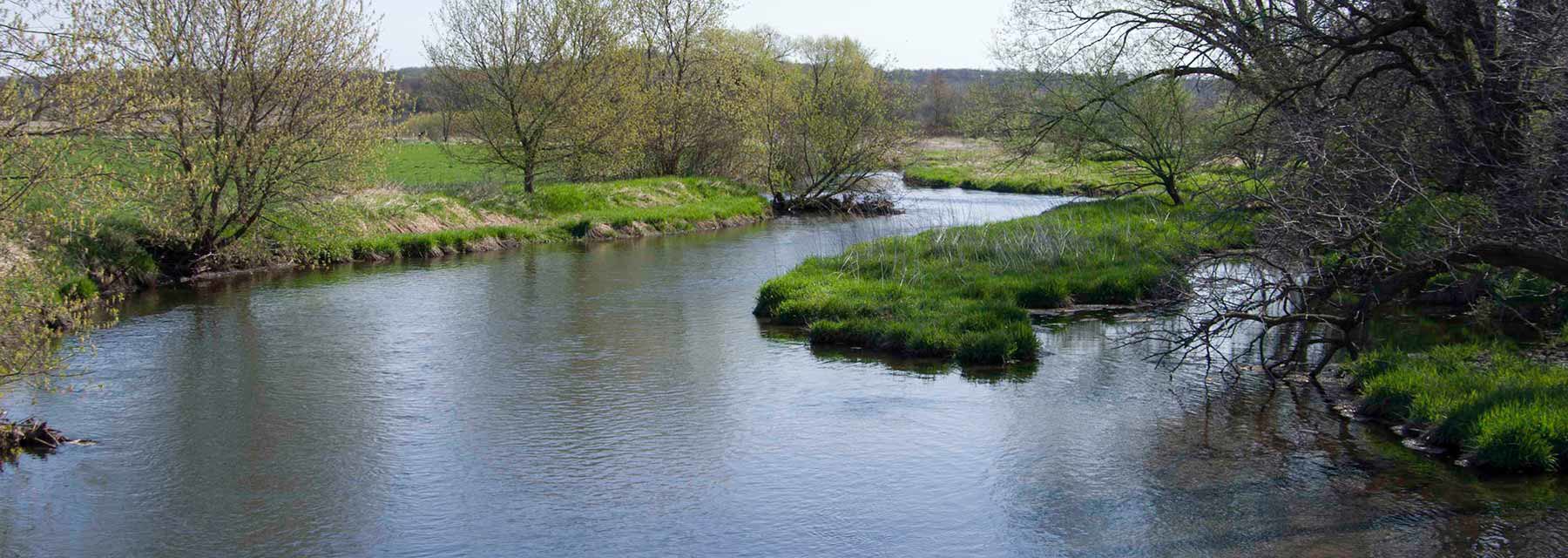
About 15 of SWTU’s finest gathered at Dane County’s Duerst property on the Sugar River as the first stage in a restoration of part of that river.
We were stage 1. Our job was to remove honeysuckle (and the buckthorn that John Freborg discovered– ouch) from an old berm along the river. Stage 2 will have the Stihl professional sawyers remove the box elders from the berm. Thanks to Sara Strassman of TUDARE, Jim Hess, and James Brodzeller of Dane County for enabling us to win the services of this volunteer crew. The third stage will be the County’s removal of the berm. That’s the key and most important step of the restoration because that reconnects the river to its floodplain and springs. Stage 3 cannot happen without Stages 1 and 2.
If invasive honeysuckle has enough years it grows into impenetrable thickets, impossible for a person to walk through. This stuff was old age, old growth honeysuckle. No way sawyers could work in its midst. It also completely shades almost all the ground. There’s just bare, highly erodible soil underneath the honeysuckle.
For about 3 hours, we sawed and hauled and have cleared about 2/3 of the berm. That might not sound like much but it’s a colossal and hard earned achievement. We might need one more work day in the fall to prepare for Stihl but we’re past the worst.
We had a good time. Jim and James had the work well planned and we had plenty of cold water, brownies, pork sticks, and, bless Dyan’s heart, homemade plain and chocolate shortbread. There’s always a chance to visit with one another and some excellent fishing spots were shared amongst the comrades in arms.
Virginia waterleaf, a wonderful native flower, somehow managed to persist in a few spots. With the honeysuckle gone, it will spread. It’s lovely, the roots help stop erosion, and it’s a great plant for some native bee species, including a specialist, the waterleaf cuckoo bee. I hope James can figure out a way to keep the waterleaf going once the berm is removed.
Everyone worked hard, cooperatively, and safely. Special mention I think is due John Freborg, who disappeared into a honeysuckle thicket. We worried that he might have fallen prey to a mutant, carnivorous honeysuckle. But he emerged triumphant from the remains of the honeysuckle and buckthorn.
Lots of regulars showed. We were happy to welcome Amy Klusmeier, a great former SWTU president, who is back in Madison full time. Jim and Bonnie Lawton took time from their care of their stretch of Tagatz Creek to show a little love to the Sugar.
Most heartfelt thanks to Jim Hess for another excellent set of spring workdays. He faced lots of weather and scheduling issues but enabled us to conserve streams in different ways in different places and learn a lot and have some fun while doing so. We all hope Jim takes a couple of months off. I don’t know that he ever really stops. He told us he had fall workdays set already. Jim, thanks and we look forward to them.



The Work Was Hard But Satisfying
Leave a Comment
Last Updated: June 30, 2025 by Drew Kasel
By Topf Wells
About 15 of SWTU’s finest gathered at Dane County’s Duerst property on the Sugar River as the first stage in a restoration of part of that river.
We were stage 1. Our job was to remove honeysuckle (and the buckthorn that John Freborg discovered– ouch) from an old berm along the river. Stage 2 will have the Stihl professional sawyers remove the box elders from the berm. Thanks to Sara Strassman of TUDARE, Jim Hess, and James Brodzeller of Dane County for enabling us to win the services of this volunteer crew. The third stage will be the County’s removal of the berm. That’s the key and most important step of the restoration because that reconnects the river to its floodplain and springs. Stage 3 cannot happen without Stages 1 and 2.
If invasive honeysuckle has enough years it grows into impenetrable thickets, impossible for a person to walk through. This stuff was old age, old growth honeysuckle. No way sawyers could work in its midst. It also completely shades almost all the ground. There’s just bare, highly erodible soil underneath the honeysuckle.
For about 3 hours, we sawed and hauled and have cleared about 2/3 of the berm. That might not sound like much but it’s a colossal and hard earned achievement. We might need one more work day in the fall to prepare for Stihl but we’re past the worst.
We had a good time. Jim and James had the work well planned and we had plenty of cold water, brownies, pork sticks, and, bless Dyan’s heart, homemade plain and chocolate shortbread. There’s always a chance to visit with one another and some excellent fishing spots were shared amongst the comrades in arms.
Virginia waterleaf, a wonderful native flower, somehow managed to persist in a few spots. With the honeysuckle gone, it will spread. It’s lovely, the roots help stop erosion, and it’s a great plant for some native bee species, including a specialist, the waterleaf cuckoo bee. I hope James can figure out a way to keep the waterleaf going once the berm is removed.
Everyone worked hard, cooperatively, and safely. Special mention I think is due John Freborg, who disappeared into a honeysuckle thicket. We worried that he might have fallen prey to a mutant, carnivorous honeysuckle. But he emerged triumphant from the remains of the honeysuckle and buckthorn.
Lots of regulars showed. We were happy to welcome Amy Klusmeier, a great former SWTU president, who is back in Madison full time. Jim and Bonnie Lawton took time from their care of their stretch of Tagatz Creek to show a little love to the Sugar.
Most heartfelt thanks to Jim Hess for another excellent set of spring workdays. He faced lots of weather and scheduling issues but enabled us to conserve streams in different ways in different places and learn a lot and have some fun while doing so. We all hope Jim takes a couple of months off. I don’t know that he ever really stops. He told us he had fall workdays set already. Jim, thanks and we look forward to them.
Share this:
Category: Event Recap, Workdays
Recent Posts
Categories