By Topf Wells
(see the end of this report for a thanks from the landowners!)
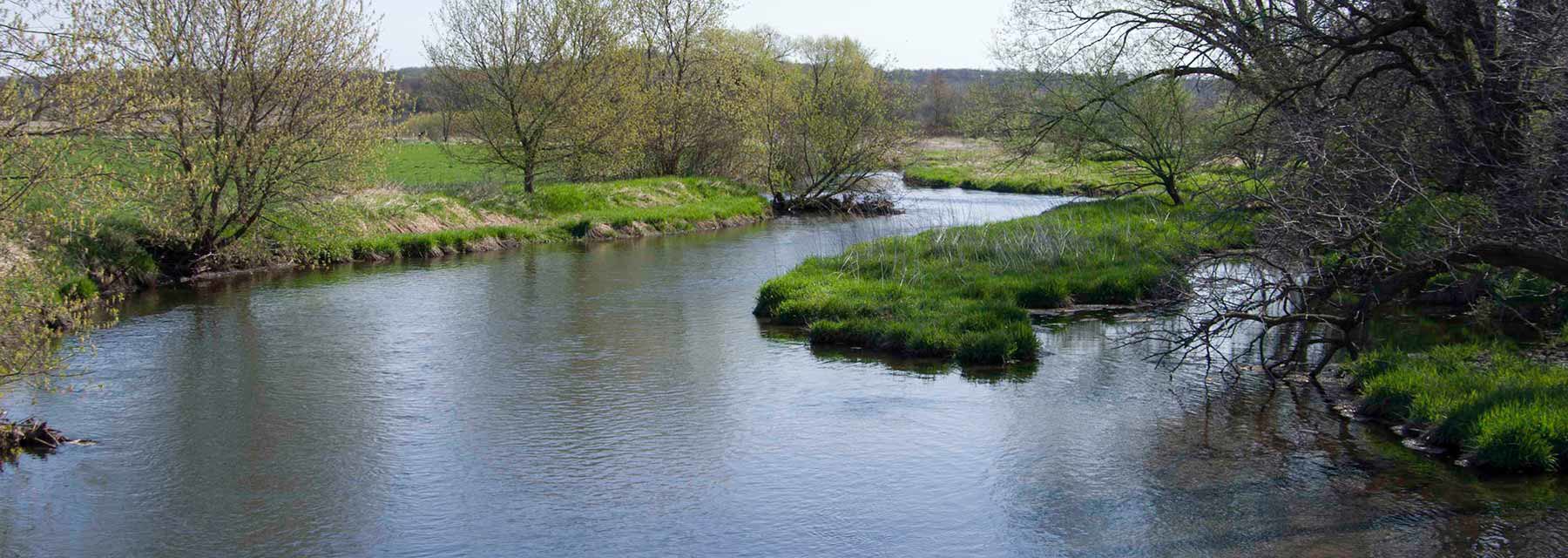
Indeed, another fabulously varied work day. The chief mission was to plant 70 swamp white and bur oaks along the newly completed DNR restoration on Smith Conley Creek on CTH H near Hollandale. Justin Haglund, the DNR fish biologist who designed the project, and Scott Harpold, Vince Schmitz, and Pat Gorman, the operations crew who refined and implemented the project, planned the day with Jim Hess. Justin and Lloyd Meng, his colleague on all fish matters, dug holes and had the trees, fencing, and other paraphernalia in place. The trees will provide shade and promote the growth of other desirable streamside vegetation. The first of many thank yous: that prep work makes tree planting fun, not drudgery.
19 SWTU volunteers and 4 DNR staff assembled, divided into teams and had all the trees properly planted in about 90 minutes. That left time for, as always, food and fun conversation. Dyan outdid herself with a cookie with dried fruit, nuts, coconut, oats, and honey– delectable and healthy. My contribution looked like a sugar cookie but the baker informed me it was a French butter cookie. The French use butter so well. And pork sticks. We spent time with the Bennetts, who own theland with one of the easements the DNR worked on. They’re excellent botanists and birders. The property has wetlands, a sedge meadow, grasslands, and a wooded hillside and bluff, fabulous bird habitats. They also located an endangered lichen on the property– gotta be great botanists to find that.
The break ended with Don Golembiewski presenting all of us with his brand new, deadly bluegill and bass bug pattern, the DRIFTLESS DECIBEL DECEIVER. Don creates them from the foam ear plugs some of us use for hearing protection on workdays. He cautions to remove the hooks before using them as ear plugs. Everyone agreed: oh yeah, these will take bluegills. Way to go and thanks, Don.
We ended the day with spreading a wet soil seed mixture and mulch on a few bare spots on the banks. Justin remarked that the DNR easements cover 82% of Smith Conley. These are old easements and most folks looking at the creek might think: big deal, looks like a pain to fish. But Justin’s surveys show the creek has a surprising amount of wild browns and a few brookies. The creek needs a lot of work but 25 years ago so did Gordon and KIttleson. Justin’s surveys and the two SWTU workdays of three years ago convinced him the creek is worth some work. Based on what we saw today and a stretch upstream where a privately funded stream and prairie restoration occured on an easement, I think he’s right.
This creek flows through a wetland with a lot of sand in the streambed. I’d give the restoration some time to heal before fishing it. Justin and Jim are also contemplating a project that would make the long walk into the creek easier. The long walk means anglers are going to have a peaceful experience.
Thanks to all who showed up, including some great Board Members and work day veterans. We were deeply honored to have Caryll Terrell, Caryll is one of the great environmental advocates in Wisconsin over the last 40 years. She helped create many of the environmental and conservation laws and procedures that protect Wisconsin’s natural resources and the folks who depend on and enjoy them. In Dane County, she served on several important commissions and always was a kind, respectful, well informed and strong voice for environmental protection. She’s a good tree planter too.
We continue to depend on Jim Hess, Dyan Lesnik, and Wayne Griffin to plan these days, lug all the equipment we need, make sure the day runs smoothly, and do a lot of the work. Thank you.
Photos courtesy Jim Hess and Dyan Lesnik. See below for many more!
The landowners say Thanks!
Everyone,
We greatly appreciate the terrific work everyone did on Saturday on the creek project. It was truly amazing that all the trees were planted in 3+ hours. We will keep our eyes on the cages and trees for many years.
Some of you probably noticed the beaver stumps along the creek in several places – these were new this past winter. Our trapper friends only caught one beaver but there must be more. So the cages and tubes are essential for maintaining the trees.
The rain we’ve been getting since Saturday is great to get the trees established – good timing!
And a huge thanks to Jim and his crew who helped fix our east bridge that was tilted over from the storm. This morning it’s still there and feels solid. If anyone knows someone who builds footbridges please let us know!
For those who don’t know this creek, it is spring fed upstream, which means it does not freeze in winter. It is amazing to see the creek open and flowing when there is snow and ice everywhere. Does this mean you can fish in winter? Perhaps, because the mallards stay all winter on the creek and must feed on something.
And the creek is stocked with brown trout every year at the bridge on Prairie Rd, less than a mile further up the valley.
Once the parking lot is finished you’ll be able to access the creek along our neighbor’s easement along the west fence. There is no easement to the creek on our property. If you come to fish and have a story to tell as a result please let us know!
Please share this message with everyone who came Saturday and others who were unable to make it.
Jim Bennett and Janet Moredock




Trees Planted, Seed Spread, and a Deadly New Fly Pattern | Workday Report 1
Leave a Comment
Posted: July 2, 2026 by Drew Kasel
By Topf Wells
(see the end of this report for a thanks from the landowners!)
Indeed, another fabulously varied work day. The chief mission was to plant 70 swamp white and bur oaks along the newly completed DNR restoration on Smith Conley Creek on CTH H near Hollandale. Justin Haglund, the DNR fish biologist who designed the project, and Scott Harpold, Vince Schmitz, and Pat Gorman, the operations crew who refined and implemented the project, planned the day with Jim Hess. Justin and Lloyd Meng, his colleague on all fish matters, dug holes and had the trees, fencing, and other paraphernalia in place. The trees will provide shade and promote the growth of other desirable streamside vegetation. The first of many thank yous: that prep work makes tree planting fun, not drudgery.
19 SWTU volunteers and 4 DNR staff assembled, divided into teams and had all the trees properly planted in about 90 minutes. That left time for, as always, food and fun conversation. Dyan outdid herself with a cookie with dried fruit, nuts, coconut, oats, and honey– delectable and healthy. My contribution looked like a sugar cookie but the baker informed me it was a French butter cookie. The French use butter so well. And pork sticks. We spent time with the Bennetts, who own theland with one of the easements the DNR worked on. They’re excellent botanists and birders. The property has wetlands, a sedge meadow, grasslands, and a wooded hillside and bluff, fabulous bird habitats. They also located an endangered lichen on the property– gotta be great botanists to find that.
The break ended with Don Golembiewski presenting all of us with his brand new, deadly bluegill and bass bug pattern, the DRIFTLESS DECIBEL DECEIVER. Don creates them from the foam ear plugs some of us use for hearing protection on workdays. He cautions to remove the hooks before using them as ear plugs. Everyone agreed: oh yeah, these will take bluegills. Way to go and thanks, Don.
We ended the day with spreading a wet soil seed mixture and mulch on a few bare spots on the banks. Justin remarked that the DNR easements cover 82% of Smith Conley. These are old easements and most folks looking at the creek might think: big deal, looks like a pain to fish. But Justin’s surveys show the creek has a surprising amount of wild browns and a few brookies. The creek needs a lot of work but 25 years ago so did Gordon and KIttleson. Justin’s surveys and the two SWTU workdays of three years ago convinced him the creek is worth some work. Based on what we saw today and a stretch upstream where a privately funded stream and prairie restoration occured on an easement, I think he’s right.
This creek flows through a wetland with a lot of sand in the streambed. I’d give the restoration some time to heal before fishing it. Justin and Jim are also contemplating a project that would make the long walk into the creek easier. The long walk means anglers are going to have a peaceful experience.
Thanks to all who showed up, including some great Board Members and work day veterans. We were deeply honored to have Caryll Terrell, Caryll is one of the great environmental advocates in Wisconsin over the last 40 years. She helped create many of the environmental and conservation laws and procedures that protect Wisconsin’s natural resources and the folks who depend on and enjoy them. In Dane County, she served on several important commissions and always was a kind, respectful, well informed and strong voice for environmental protection. She’s a good tree planter too.
We continue to depend on Jim Hess, Dyan Lesnik, and Wayne Griffin to plan these days, lug all the equipment we need, make sure the day runs smoothly, and do a lot of the work. Thank you.
Photos courtesy Jim Hess and Dyan Lesnik. See below for many more!
The landowners say Thanks!
Everyone,
We greatly appreciate the terrific work everyone did on Saturday on the creek project. It was truly amazing that all the trees were planted in 3+ hours. We will keep our eyes on the cages and trees for many years.
Some of you probably noticed the beaver stumps along the creek in several places – these were new this past winter. Our trapper friends only caught one beaver but there must be more. So the cages and tubes are essential for maintaining the trees.
The rain we’ve been getting since Saturday is great to get the trees established – good timing!
And a huge thanks to Jim and his crew who helped fix our east bridge that was tilted over from the storm. This morning it’s still there and feels solid. If anyone knows someone who builds footbridges please let us know!
For those who don’t know this creek, it is spring fed upstream, which means it does not freeze in winter. It is amazing to see the creek open and flowing when there is snow and ice everywhere. Does this mean you can fish in winter? Perhaps, because the mallards stay all winter on the creek and must feed on something.
And the creek is stocked with brown trout every year at the bridge on Prairie Rd, less than a mile further up the valley.
Once the parking lot is finished you’ll be able to access the creek along our neighbor’s easement along the west fence. There is no easement to the creek on our property. If you come to fish and have a story to tell as a result please let us know!
Please share this message with everyone who came Saturday and others who were unable to make it.
Jim Bennett and Janet Moredock
Share this:
Category: Event Recap, Workdays
Recent Posts
Categories
Partners